
pH portable meters

-

FiveGo™ F2 meters
Producer: Mettler Toledo
Nr CAT:
Temperature [° C]: 0–100
Accuracy: 0,01/±0,01
check -

SevenGo Duo™ meters
Producer: Mettler Toledo
Nr CAT:
Measurement range: 0.00-14.00 pH
Temp. Max [° C]: 105
check -

-

SevenGo Duo Pro™ meters
Producer: Mettler Toledo
Nr CAT:
Temp. Max [° C]: 130
Resolution of indications [° C]: pH: 0.1/DO: 0.1, pH/mV: 0.1/conductivity: 0.1 , pH: 0.1 DO: 0.1
check -

CyberScan multi-parameter portable meters
Producer: Thermo Scientific
Nr CAT:
Temperature [° C]: 0,0 to 100,0 ° C , -10,0 to 110,0 ° C
Description: -2 to 16,00 pH, 0,00 to 14,00 pH
check -

Multi-parameter portable pH/Cond 3320 meter
Producer: WTW
Nr CAT:
Description: -2.000 - 19.999 pH
Other: -2500 to 2500 mV
check -

pH/Oxi 340i multi-parameter portable meters
Producer: WTW
Nr CAT:
Parameter: pH, mV, 02, p02, oC
Temperature [° C]: -5,00 to 105,00
check -
Multi 340i multi-parameter portable meters
Producer: WTW
Nr CAT:
Parameter: pH. mV, O2, pO2, X, Sal, oC
Temperature [° C]: -5,0 to 105,0
check -

Multi 3320 multi-parameter portable meters
Producer: WTW
Nr CAT:
Parameter: pH, mV, ION, O2, pO2, X, Sal, oC
check -
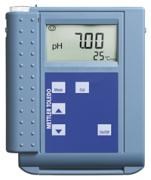
Portable pH meter 1120 IP66, Ex version
Producer: Mettler Toledo
Nr CAT:
Parameter: pH, mV,
Accuracy: <0.01 pH / <0.1 % o.m. ±0.3 mV
check -
Portable pH meter 1140 bi-directional RS232 communication, Ex version
Producer: Mettler Toledo
Nr CAT:
Parameter: pH, mV
Accuracy: <0.01 pH / <0.1 % o.m. ±0.3 mV
check -

Portable pH meter Pro2Go
Producer: Mettler Toledo
Nr CAT:
Parameter: pH, mV, temperatura
Measurement range: -2 do 20 pH
check -

Waterproof multifunctional field and laboratory instrument CX-401
Producer: Elmetron
Nr CAT:
Parameter: pH, mV, conductivity/salinity, O2, temperature
Temp. Max [° C]: 199
check -

Acidity tester for soil
Producer: Draminski
Nr CAT:
Parameter: pH, mV, temperature
Temp. Max [° C]: 130
check -
FiveGo™ F3 meters
Producer: Mettler Toledo
Nr CAT:
Temperature [° C]: 0,0 to 100
Accuracy: ±0,5%
check -

FiveGo™ F4 meters
Producer: Mettler Toledo
Nr CAT:
Temperature [° C]: 0,0 to 50,0
Accuracy: 0,1 / ±1%
check -

Pocket pH ORP meter
Producer: Milwaukee
Nr CAT:
Battery life: approx. 300 hours of use, approx. 1500 hours of use
check -

-

-

MW PRO portable pH meter
Producer: Milwaukee
Nr CAT:
Accuracy: ±0,2 pH, ±0,02 pH, ±0,02 pH/±0,5°C, ±5 mV
Battery life: approx. 300 h
check -

-

Portable SD 305 pH/ORP meter
Producer: Lovibond
Nr CAT:
Description: pH / Redox / Temp.
Parameter: pH -2 – 16 / Redox -2000,0 – 2000,0 mV / Temp. -5 - 150 ° C, pH -2 – 16 / Redox -1999.9 - 1999.9 mV / Temp. -5 - 150 ° C
check -

-

Portable pH meter Testo 205
Producer: Testo
Nr CAT:
Measurement range: FROM 0 TO +60 °C - NTC /FROM 0 TO 14 pH - ELECTRODE
Scale: 135 g
check -

Portable pH meter 206 - pH1 and pH2
Producer: Testo
Nr CAT:
Measurement range: FROM 0 TO 14 pH / FROM 0 TO +60 °C
Work scope [° C]: FROM 0 TO +60 , FROM 0 TO 60
check


Ph Lab Meter
A laboratory meter is a precise measuring instrument used to determine the activity of hydrogen ions in solutions, thanks to which it allows for an unambiguous assessment of their acidic or alkaline reaction. The device works by measuring the electric potential difference between the measuring electrode and the reference electrode, which allows for fast and accurate reading of the pH values in the tested samples.
In laboratory practice, the pH meter is used in chemical, biological, environmental and industrial analyses, where even small deviations from the correct pH can affect the course of the reaction or the quality of the product. Depending on the application, portable and stationary pH meters and multi-parameter meters are used, which additionally measure temperature, conductivity or redox potential.
Design and technical parameters of measuring devices
A typical pH meter consists of a measuring unit and a combined or separate electrode (measurement and reference). The key component is the glass electrode, whose membrane reacts to the concentration of H⁺ ions in the solution.
Modern models such as the Elmetron CP-505, Elmetron CP-511 or Lab 865 use digital signal processing, automatic temperature compensation and high measurement resolution of up to 0.001 pH, which is important for high-precision laboratory tests.
Specificity of selection and automatic electrode diagnostics
The choice of electrode depends on the type of sample – different probes are used for water, others for soil or high-viscosity solutions. For models such as the pH meter for soil, mechanical resistance and the ability to work in a semi-solid environment are important.
Many devices have an electrode diagnostic function that informs about electrode wear, signal stability and response quality, which avoids measurement errors.
Metrological requirements and advanced meter tuning methods
pH meter calibration is crucial for reliable results and should be performed according to certain rules:
The calibration is carried out:
- daily or before each series of measurements with high accuracy,
- once a week for occasional use,
- absolutely after cleaning or replacing the electrode.
The calibration process always takes place at a controlled temperature, preferably 25°C. A pH buffer of 7.00 is used first, followed by a second solution – pH 4.01 or pH 10.01, depending on the measuring range.
After calibration, the parameters of the electrode, including the slope, and the isopotential point, are checked, which determine its efficiency and measurement accuracy.
In addition to calibration, calibration is also used, i.e. a formal check of the measurement consistency of the device, which should be performed at least once a year in laboratory conditions.
Principles for cleaning and safe storage of sensors
pH electrodes require regular maintenance to maintain the stability and repeatability of measurements. After each use, they should be rinsed thoroughly with demineralized water, removing any sample residue that could interfere with subsequent readings. In the case of more stubborn dirt, dedicated cleaning solutions are used, selected for the type of substances being analyzed, e.g. protein deposits or chemical residues.
Equally important is the proper storage of the electrode – as a standard, it is placed in a special KCl solution, which prevents the glass membrane from drying out and maintains its appropriate electrochemical properties. Improper storage, e.g. in distilled or dry water, can lead to a shortened electrode life and a deterioration in measurement accuracy.
Compliance with quality standards and performance recording systems
Modern pH meters meet the requirements of laboratory standards and allow automatic storage of measurement results in the device's memory. This gives the user constant access to the measurement history and can quickly compare data without the need for manual documentation, which reduces the risk of errors.
Many models also have the function of exporting data to LIMS systems, which significantly improves archiving and quality supervision in industrial and research laboratories. Such solutions facilitate reporting, standardize documentation, and support compliance with quality control procedures in modern laboratories.
Multiparameter physicochemical analysis in industrial applications
Advanced pH meters are increasingly part of multiparameter systems that allow you to measure several important physicochemical quantities such as pH, temperature, conductivity or ion concentration at the same time. This allows a single probe or set of sensors to provide a more complete picture of the sample being tested without the need for multiple separate devices.
In combination with devices such as conductivity meters , comprehensive liquid analysis in real time is possible, which significantly improves work in production and laboratory conditions. This approach allows you to detect parameter deviations more quickly and react to changes in process quality.
Solutions of this type are used primarily in water quality control, food and chemical industries and environmental studies, where it is important to simultaneously assess several sample parameters and their mutual dependencies.