
Desimeters, thermodensimeters and alcohol meters

-

Alcohol meter-alcohol indicator
Producer: GOMAR
Nr CAT:
Measurement range [o]: 0-100
Accuracy: 1-5
check -

Thermodensimeters and universal densimeters
Producer: GOMAR
Nr CAT:
Measurement range [o]: 0,600-1,7000
Accuracy: 0.001g/cm
check -

Thermodensimeter for mineral oil
Producer: GOMAR
Nr CAT:
Measurement range [o]: 0,610-1,050 g/cm3
check -

-
-
Thermodensimeter for milk
Producer: GOMAR
Nr CAT:
Measurement range [o]: 1,015-1,045 g/cm3
Temperature [° C]: -10°C do +30°C
check -
-

-
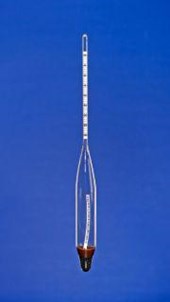
Densimeter for soil sedimentation analysis
Producer: GOMAR
Nr CAT:
Measurement range [o]: -10 ÷ +30 kg/m3
check -

-

-

Salt meter
Producer: GOMAR
Nr CAT:
Measurement range [o]: 0 ÷ 350 kg/m3, 0-60 kg/m3/ 0,995-1,040 g/cm3, 0-350 kg/m3
Model: Salt meter, thermo-salt meter
check -


Densimeter – definition and basic information
A densimeter is an instrument for measuring the density of liquids, belonging to the group of hydrometers and more broadly to the category of density meters. The device works on the principle of buoyancy force (Archimedes' law), which means that the degree of immersion of the float depends directly on the density of the liquid being tested.
Universal densimeters and thermodensimeters are designed for fast measurement of liquid density under specific reference conditions, most often at a temperature of 20°C. These devices are used in laboratory and industrial analyses, where fast reading without complicated calculations is important.
Principle of operation and physical basis of measurement
The operation of the densimeter is based on hydrostatic buoyancy. The float submerges in the liquid until a balance is reached between its weight and the buoyancy force acting on the side of the liquid.
In practice, this means that:
- in liquids with a higher density, the densimeter is immersed more shallowly,
- in liquids with a lower density, it sinks deeper.
This relationship allows you to directly read the density value from the scale of the instrument. Results can be expressed in g/cm³ or kg/m³, depending on the industry standard.
Terminology and Nomenclature Differences of Laboratory Equipment
In laboratory practice, mistakes often occur resulting from similar device names. The most important distinction concerns:
- densimeter – an instrument for measuring the density of liquids, operating on the principle of buoyancy,
- hydrometer – the general name of float density measuring instruments,
- densitometer – a medical device for measuring bone mineral density (BMD, T-score), used in the diagnosis of osteoporosis.
The difference is important because the densimeter belongs to laboratory equipment, while the densitometer is used for medical diagnostics and is not used to measure liquids.
Classification of densimeters and related devices
Densimeters are available in several design variants, which differ in the range of applications and equipment. The most common are:
- universal densimeters for a wide range of liquids,
- thermodensimeters with built-in temperature measurement,
- classic float instruments for fast readings,
- urometers used to test urine density,
- specialized industrial hydrometers.
Such differentiation allows you to choose the right device for a specific analytical application.
Practical use in industry and laboratories
The densimeter is widely used in many industries where liquid density control is critical to process quality.
It is most often used in:
- automotive to control the electrolyte in batteries,
- chemical industry for the analysis of technological solutions,
- agriculture in the assessment of RSM liquid fertilizers,
- refrigeration for the control of coolants,
- diagnostics when measuring urine density (urometry),
- food industry in the control of sugar solutions and syrups.
In each of these cases, the densimeter allows you to quickly assess the parameters of the liquid without the need for advanced electronic equipment.
Measurement methodology and interpretation of results
The measurement performed with the use of a densimeter consists in its free immersion in the tested liquid and reading the value at the point where the liquid level intersects with a scale.
For the result to be reliable, it is necessary to ensure:
- no air bubbles,
- stable liquid temperature (usually 20°C),
- Mix the sample properly before measuring.
Once these conditions are met, the reading can be treated as a direct density value.
Calibration of the densimeter in laboratory conditions
Proper calibration of the device is crucial to maintain the accuracy of measurements. The standard procedure includes:
- Thorough cleaning and drying of the densimeter,
- Preparation of distilled water at a temperature of 20°C,
- Immersion of the device without the formation of air bubbles,
- Reading the reference value,
- Verification of compliance of the result with the value of 1,000 g/cm³,
- Repeat measurement to confirm stability.
Distilled water is a basic benchmark because its density at 20°C is strictly defined.
Accuracy Inspection and Verification Procedures
In professional laboratories, densimeters are subject to periodic metrological control. Verification involves comparing the results with density standards and alternative measurement methods such as pycnometer or electronic density meters.
Regular inspection ensures repeatability of results and compliance with the requirements of quality standards used in industry.
Measuring ranges of densimeters
Typical measurement ranges include:
- 600 - 0.700 g/cm³
- 700 - 0.800 g/cm³
- 800 - 0.900 g/cm³
- 900–1,000 g/cm³
- 1,000–1,100 g/cm³
- 1,100–1,200 g/cm³
- 1,200–1,300 g/cm³
- 1,300–1,400 g/cm³
- 1,400–1,500 g/cm³
- 1,500–1,600 g/cm³
- 1,600–1,700 g/cm³
Each range corresponds to different types of liquids, so choosing the right densimeter is crucial for the correct measurement.