
Spectrophotometers and spectroscopes

-

Handheld spectroscope 1500 series
Producer: Kruess
Nr CAT:
Prism: Amicinprism, Amicinprisma
Options: Linear dispersion 40 mm, Linear dispersion 60 mm
check -

Handheld spectroscope 1700 series
Producer: Kruess
Nr CAT:
Observation tube: Movable, with locking screw
Prism: 1718
check -

Gemmological spectroscopes
Producer: Kruess
Nr CAT:
Description: CF = angle dispersion 7 °
Power supply: Automatically switchable 110-240 V power supply, N / A
check -

Spectrophotometer Zuzi
Producer: Auxilab
Nr CAT:
Wavelength range: 200-1000 nm, 190-1100 nm, 190-900 nm
Bandwidth: 5 nm, 2 nm, 4 nm, variable: 0,5/1/2/4/5 nm, constant; range 0,1-5 nm (spacing 0,1 nm)
check -

-

Reagents for enzymatic and colorimetric analysis
Producer: Steroglass
Nr CAT:
Description: ACETALDEHYD, ACETIC ACID, ACETIC ACID (auto), ANTOCYANINS, ASCORBIC ACID, CALCIUM, CATECHINES, CHLORS , CITRIC ACID , COLOR, COPPER, GLYCERINE , D-GLUCONIC ACID , IRON, D-LACTIC ACID , L-LACTIC ACID, MAGNESIUM, D-MALIC ACID , L-MALIC ACID , L-MALIC ACID (AUTO), PYRUVIC ACID, POLYPHENOLS, POTASSIUM, STABILITY OF PROTEINS, ALPHA AMINO NITROGEN, AZOT AMMONIA, GLUCOSE-FRUCTOSE, GLUCOSE + FRUCTOSE (SEPARATE), SUCROSE STARTER, GLUCOSE-FRUCTOSE (auto), GLUCOSE (auto), FREE SO2, TOTAL SO2, TARTARIC ACID
check -

Semi-automatic multi-parameter analyzer One
Producer: Steroglass
Nr CAT:
Description: More than 132 programmable methods
Model: SQAS073682
check -

Hyperlab Plus and Basic multi-parameter analyzer
Producer: Steroglass
Nr CAT:
Parameter: SQRQ060129, SQRQ074351
check -

-
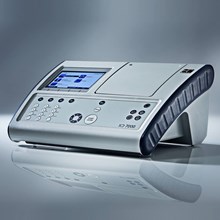
Spectrophotometer XD7000 XD7500
Producer: Lovibond
Nr CAT:
Description: Measurement of 150 parameters, VIS technology, Measurement of 150 parameters, UV-VIS technology
check -

SELECTA spectrophotometer
Producer: Auxilab
Nr CAT:
Wavelength range: 325-1000 nm, 190-1100 nm
Bandwidth: 5 nm, 4 nm, 2 nm
check -


Spectrophotometers and spectroscopes
Spectrophotometry and spectroscopy are methods that test the properties of samples. They use light to check what the samples are made of. In practice, they allow you to "see" what cannot be assessed with the naked eye – e.g. the concentration of a substance in a solution or the chemical composition of a material.
Measurement results: quantitative analysis vs. qualitative observation
In the case of a spectrophotometer, specific numbers are the most important. The device shows how much light has been absorbed, and based on this, the concentration of the substance in the sample can be calculated. Therefore, it is a tool typically for quantitative analysis.
A spectroscope works differently – it does not give numerical results, but shows the spectrum of light. This allows you to recognize what substances are in the sample, but without determining their exact quantity.
Internal structure and path of light in measuring apparatus
Although a spectrophotometer and a spectroscope may look different, their principle of operation is similar. The light passes through a narrow slit, then is "ordered" by a collimator and separated into different wavelengths by a prism or diffraction grating.
In the spectrophotometer, this light still passes through the sample and goes to the detector, which converts it into a numerical result. In a spectroscope, the user simply observes the resulting spectrum.
Relationship between radiation absorption and sample concentration
The more substances are in a sample, the more light is absorbed by it. This is the basic principle of operation of a spectrophotometer, which allows you to link the intensity of absorption with the amount of the substance being tested.
On this basis, it is possible to determine the concentration in solutions very precisely, provided that the measurement is performed under controlled conditions. Proper calibration of the device and proper sample preparation are crucial here, ensuring repeatability and reliability of results.
Single-beam and double-beam designs in laboratory practice
There are two basic types of spectrophotometer designs used in laboratories. Simpler devices operate in a single-beam system – this means that the sample is measured first, and then the background or reference sample is measured separately. This solution is uncomplicated, but requires greater control over the measurement conditions.
More advanced models are dual-beam systems. In this case, the light beam is split so that the device analyzes the sample and reference at the same time. This allows for ongoing correction of signal changes and ensures more stable and repeatable results, especially for longer measurement series.
Ultraviolet and visible light ranges and microvolume techniques
Most spectrophotometers operate in the UV-Vis range, i.e. they use ultraviolet radiation and visible light. This makes it possible to carry out a wide range of analyses – from simple tests of chemical solutions to more complex analyses of biological samples.
Micro-volume techniques, in which a minimum amount of sample is sufficient to perform a measurement, are also becoming increasingly popular. This solution saves test material, reduces analysis preparation time and increases the convenience of working in the laboratory.
Identification of molecular structures using infrared radiation
Infrared spectroscopy allows you to check what chemical groups a substance is made of. The spectroscope then shows characteristic "patterns" that help identify the material.
This is very useful when you need to quickly check what's in a sample without performing complicated analyses.
Absorption and emission methods in atomic level research
In more advanced analyses, spectrophotometers and spectrometers allow to study not only chemical compounds, but also individual elements. This is done based on how atoms absorb or emit light.
This makes it possible, for example, to detect metals in environmental samples or to control the composition of raw materials.
Fluorescence measurements after material excitation
In this method, the sample is first "stimulated" with light and then its luminosity is measured. The spectrophotometer captures this very fine light, which makes it possible to detect even very small amounts of substances.
This is one of the most sensitive analytical methods.
Advanced magnetic resonance imaging and mass analysis techniques
Some spectroscopic techniques go even further – they are no longer based only on light. They use, for example, the magnetic properties of molecules or their mass.
This allows you to accurately determine the structure of chemical compounds and analyze them in great detail.
Use of optical methods in medicine, forensics and industry
Spectrophotometers and spectroscopes are used in many industries. In medicine, they help in diagnostics, in forensics in the identification of substances, and in industry in product quality control.
In laboratories, they often work together with other devices such as photometers, polarimeters or calorimeters to create complete kits for material analysis.
In this type of application, devices available in Danlab's offer are used, adapted to work in modern research and industrial laboratories.