
Spherical flasks
-

Spherical round-bottomed flask, long neck
Producer: Archem
Nr CAT:
Capacity: 50ml, 100ml, 250ml, 500ml, 1000ml, 2000ml
check -

Spherical round-bottomed flask, short neck
Producer: Archem
Nr CAT:
Capacity: 50ml, 100ml, 250ml, 500ml, 1000ml, 2000ml
check -

Round-bottomed spherical flask with ground joint
Producer: Archem
Nr CAT:
Capacity: 50ml, 100ml, 250ml, 500ml, 1000ml, 2000ml
check -

Flat-bottomed spherical flask with ground joint
Producer: Archem
Nr CAT:
Capacity: 50ml, 100ml, 250ml, 500ml, 1000ml, 2000ml
check -

Flat-bottomed spherical flask with narrow neck
Producer: Archem
Nr CAT:
Capacity: 50ml, 100ml, 250ml, 500ml, 1000ml, 2000ml
check -
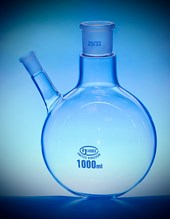
Spherical, double-necked flask with ground joint
Producer: Megan
Nr CAT:
Capacity: ml, 250, 500, 1000, 2000, 4000, 6000
Parameter: Neck 1 ground joint, 29/32, 45/40, 60/46
check -

Spherical, three-necked flask with ground joint
Producer: Megan
Nr CAT:
Capacity: ml, 250, 500, 1000, 2000, 4000, 6000
Parameter: Neck 1 ground joint, 29/32, 45/40, 60/46
check
Spherical round-bottomed and flat-bottomed flasks
It is difficult to imagine a modern laboratory without spherical flasks, which are the foundation of daily research work. Models with a rounded bottom are excellent at evenly dissipating thermal energy, which minimizes the risk of cracks during intense heating. Their flat-bottomed counterparts, on the other hand, offer full stability on the countertop, making them an ideal choice for the safe storage of pre-prepared reagents.
The use of high-quality borosilicate glass, compliant with the rigorous ISO 1773 standard, provides the vessels with exceptional mechanical and chemical resistance. Additional edge reinforcement effectively protects the edges from accidental chipping, extending the life of the equipment even with heavy use. The most important advantages of this solution are:
- uniform dissipation of thermal energy during thermal processes,
- high resistance to rapid temperature changes and corrosive substances,
- compliance with the strict ISO 1773 quality standard,
- reinforced edging to protect against mechanical damage,
- Wide range of capacities from 50 ml to 6 liters.
Boro 3.3 and PFA borosilicate glass
In the production of laboratory flasks, BORO 3.3 borosilicate glass is the leading factor, eagerly chosen by renowned brands such as Simax or Glassco. Modern material technologies offer a number of key properties for professional research:
- excellent resistance to sudden temperature jumps preventing dishes from breaking during heating,
- Total PFA water repellency ideal for precise trace analysis
- the possibility of multiple sterilization in an autoclave to increase the functionality of the equipment,
- effective barrier to UV radiation provided by specialized orange glass,
- flexible PUR coating to protect personnel from spatter and aggressive contents.
A properly selected raw material is the foundation of stable distillation and a guarantee of reliable storage of even the most demanding chemical reagents.
Single- and multi-neck flasks for apparatus
While standard single-neck models are suitable for routine tasks, advanced laboratory processes require the use of professional multi-neck stocks. Such dishes allow for flexible configuration of the set, while ensuring full safety of work. Thanks to additional inlets, you gain the ability to perform such tasks as:
- free expansion of laboratory equipment,
- precise and ongoing temperature control,
- safe dosing of reagents during the reaction,
- conducting intensive mixing without interrupting work,
- maintaining impeccable tightness of the entire system.
Megan's offer includes glass with capacities from 250 ml to 6 liters, which allows you to perfectly adjust the vessel to the scale of the research carried out. The use of standardized 29/32 grinds guarantees a perfect fit of individual elements, which effectively prevents the escape of fumes. This is critical for precision and safety, especially during demanding, multi-step chemical processes.
NS laboratory grinding – tightness and safety
Standard NS laboratory grinding is the foundation of tightness, which eliminates the need for additional seals or plugs. Their precision is crucial, especially when working under vacuum, where the perfect fit of the components minimizes the risk of dangerous implosions and vapor escape. However, if the apparatus requires more freedom, it is worth choosing spherical connectors, which effectively eliminate mechanical stress on the glass.
Thanks to full standardization, combining components into stable sets is simple and intuitive. The choice of vessel depends on the specifics of the research, and high-quality borosilicate glass provides the vessels with exceptional durability:
- Kjeldahl flask with a characteristic elongated neck, irreplaceable for determining the nitrogen content,
- Schlenk models with a side tap for safe operation in an inert gas atmosphere,
- distillation flasks, whose spherical form promotes even heat distribution and boiling,
- NS laboratory grindings guaranteeing excellent tightness without additional connecting elements,
- spherical joints that reduce the risk of glass breakage by eliminating mechanical stress.
Kjeldahl, Schlenka and distillation spherical flasks
Understanding the purpose of specialized glass significantly improves research work and increases the precision of results. Specialized dishes are designed with specific processes in mind, which allows for optimization of operations and protection of valuable substances.
It is worth paying attention to the following elements:
- Kjeldahl flask, irreplaceable for nitrogen determination and mineralization due to its structure that prevents substance loss,
- receiver, used for precise collection of liquefied liquids in distillation processes,
- pear-shaped vessels, which minimize sample loss and accelerate solvent evaporation,
- Witt models, characterized by reinforced walls resistant to sudden pressure changes,
- sanding clips and matching plugs to ensure maximum tightness of all joints.
Remember that a properly selected vessel capacity not only increases the efficiency of the reaction, but above all guarantees the safety of personnel, which should be a priority in every professional laboratory.
Choosing a spherical stock – capacity and accessories
The choice of laboratory vessel depends primarily on the scale of the experiment and the available equipment. Spherical models require the use of a dedicated heating canopy, while the stability of the entire system is ensured by a solid tripod with appropriate paws. Cork pads are also an essential element, as they protect the heated glass from thermal shock and breakage.
These vessels are the foundation of professional test kits, proving themselves in the following processes:
- precise distillation of ingredients,
- extraction in Soxhlet apparatus,
- evaporation in vacuum evaporators,
- specialized determination of iodine value,
- Sample identification thanks to a matte description field.
Choosing certified glass is a key investment in the reproducibility of results and work safety. A well-thought-out selection of equipment allows you to maintain the highest standards, making everyday tasks in the laboratory both accurate and fully professional.