
Erlenmayer flask
-

Erlenmeyer flasks with a narrow neck
Producer: Megan, Labglass
Nr CAT:
Capacity: 25ml, 50ml, 100ml, 200ml, 250ml, 300ml, 500ml, 1000ml, 2000ml, 3000ml, 5000ml
check -

Erlenmeyer flasks with a wide neck
Producer: Megan, Labglass
Nr CAT:
Capacity: 25ml, 50ml, 100ml, 200ml, 250ml, 300ml, 500ml, 1000ml, 2000ml, 3000ml, 5000ml
check -

Vacuum flasks with connection
Producer: Megan
Nr CAT:
Capacity: ml, 100ml, 250ml, 500ml, 1000ml, 2000ml
Other: Side connection (material), Plastic, Glass
check -

Erlenmeyer flasks with narrow neck, DURAN glassware
Producer: Megan, Labglass
Nr CAT:
Capacity: 25ml, 50ml, 100ml, 200ml, 250ml, 300ml, 500ml, 1000ml, 2000ml
check -
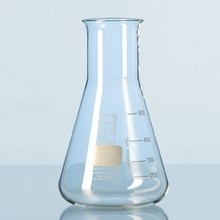
Erlenmeyer flasks with wide neck, DURAN glassware
Producer: Megan, Labglass
Nr CAT:
Capacity: 25ml, 50ml, 100ml, 200ml, 250ml, 300ml, 500ml, 1000ml, 2000ml
check -

Erlenmeyer flasks with ground, DURAN glass
Producer: Megan, Labglass
Nr CAT:
Capacity: 25ml, 50ml, 100ml, 200ml, 250ml, 300ml, 500ml, 1000ml, 2000ml
check -
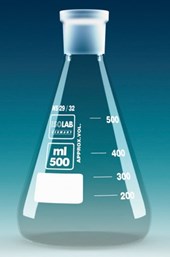
Erlenmeyer flasks with ground joint
Producer: Megan, Labglass
Nr CAT:
Capacity: 25ml, 50ml, 100ml, 200ml, 250ml, 300ml, 500ml, 1000ml, 2000ml
check -

Flasks for determination of iodine number
Producer: Megan, Labglass
Nr CAT:
Capacity: 50ml, 100ml, 250ml, 300ml, 500ml, 1000ml
check
Erlenmayer flask for many laboratory applications
The Erlenmayer flask, commonly known as the Erlenmeyer flask, is an indispensable piece of laboratory equipment. Its characteristic, conical shape and flat bottom ensure stability, and the tapered neck effectively protects against accidental escaping of contents. The use of cookware from renowned manufacturers, such as Megan or Labglass, guarantees the highest quality and safety of work.
Depending on their needs, users can choose dishes made of borosilicate 3.3 glass, which is characterized by high thermal and chemical resistance, or opt for lightweight and durable polycarbonate. The key functionalities of these vessels are:
- precise titration to reduce evaporation,
- safe mixing of liquids without the risk of splashing,
- conducting sterile microbiological cultures,
- heating and storage of aggressive reagents,
- multiple autoclave sterilization,
- convenient dosing of substances in models with a wide neck.
Available capacities, such as 500 ml and 1000 ml, allow the vessel to be perfectly adapted to the specifics of the test, ensuring full compliance with applicable quality standards.
Flasks made of BORO 3.3 glass and polycarbonate
Professional laboratory equipment is the foundation of safety. BORO 3.3 borosilicate glass guarantees resistance to temperature changes and aggressive chemicals. The highest quality is provided by DURAN products. An alternative is polycarbonate cookware – lightweight, durable and BPA-free, which reduces the risk of breakage.
The scales on the flasks are used to determine the volume. Measuring cylinders are essential for precise measurements. Our offer provides flexibility with a wide selection of solutions:
- durable BORO 3.3 glass,
- DURAN products,
- BPA-free polycarbonate cookware,
- Megan and Labglass assortment,
- capacity from 25 ml to 5 liters.
Conical flasks with narrow and wide neck
The choice between a narrow and wide neck of the stock depends on the specifics of the planned examination. The narrow inlet effectively reduces evaporation and protects against liquid splashing, while the wide opening facilitates the introduction of loose substances and precise pipette operation.
The use of borosilicate glass makes the dishes resistant to thermal shock and aggressive reagents.
- tight connection with the apparatus thanks to standardized cuts,
- effective filtration in vacuum models with a side port,
- additional edge reinforcement to protect against cracks,
- high chemical resistance of seals made of PTFE,
- safe sterilization in an autoclave to maintain microbiological purity,
- precise threading in accordance with strict ISO standards.
The high quality of materials such as PBT or PP caps raises safety standards in a demanding laboratory environment. Investing in certified equipment ensures not only the precision of measurements, but also the exceptional durability of the vessel during daily, intensive use.
Application of the Erlenmayer flask in the laboratory
The conical flask, known as the flask flask, is the foundation of laboratory equipment. Its design is ideal for titration, allowing the solution to be stirred without splashing the contents. Placing it under the burette makes it easier to capture the moment of color change, which is crucial for analysis.
The vessel is characterized by high thermal resistance, proving itself during distillation and recrystallization. The narrow neck restricts evaporation and the condensation returns to the solution. The use of this glass brings numerous benefits:
- conical shape for easy mixing of liquids,
- narrow neck limiting reagent losses,
- high resistance to temperature changes,
- safety when working with corrosive substances,
- stable vessel construction,
- the ability to precisely observe the reaction.
The use of heather pebbles prevents liquid ejection, guaranteeing process control and operational safety.
Sterility and autoclaving in microbiology
In microbiology, vascular sterility is an absolute priority, because without it, no test will be reliable. Conical flasks, commonly used for the preparation of media and cell cultures, are normally autoclaved at 121°C. It is the combination of high temperature and pressure that guarantees the effective elimination of all microorganisms.
Today's plastic tableware must meet stringent standards that are essential for delicate processes such as the isolation of genetic material. Professional laboratory accessories are distinguished by a set of key features:
- full sterility confirmed by certificates,
- non-pyrogenic properties protecting samples,
- absence of DNase and RNase enzymes,
- high resistance to extreme working conditions,
- availability of specialized locking systems.
Additional protection is provided by Filter caps with a hydrophobic membrane, which allow sterile gas exchange, and Plug variants, which allow for tight shut-off of the vessel. Work with cobs is often carried out in incubators and shakers, which take care of optimal aeration and stable growth of cultures. Interestingly, these solutions are also used in brewing to multiply yeast starters, which translates into clean and safe fermentation of beer.
Selection of parameters and standards of a conical flask
The precise selection of laboratory glassware is the foundation for reliable testing, which is why the vessels must absolutely meet stringent technical standards. Standards that determine the dimensions and durability of equipment play a key role, which guarantees full repeatability of results and safety of work in the laboratory.
The following parameters are crucial in the certification and production process:
- ISO 1773 standard specifying standard flask dimensions,
- DIN 12380 and DIN 12385 guidelines for wall thickness,
- tightness of grinding joints in accordance with DIN 12242,
- ISO 9001 and ISO 13485 quality systems for in vitro diagnostics,
- production in controlled clean zones of ISO 8 class,
- Regular calibration to almost completely eliminate measurement errors.
This approach allows for safe work in the most demanding areas of medicine and science. The use of certified glass effectively minimizes the risk of contamination and provides the highest protection for each analyzed sample.