
Crystallizers
-

Boro crystallizer 3.3 with spout
Producer:
Nr CAT:
Capacity: [ml], 20, 40, 60, 100, 150, 300, 500, 900, 2000, 3500
Dimensions: diameter [mm], 40, 50, 60, 70, 80, 95, 115, 140, 190, 230
check -

Boro crystallizer 3.3
Producer:
Nr CAT:
Capacity: [mm], 20, 40, 60, 100, 150, 300, 500, 900, 2000, 3500
Dimensions: diameter [mm], 40, 50, 60, 70, 80, 95, 115, 140, 190, 230
check -
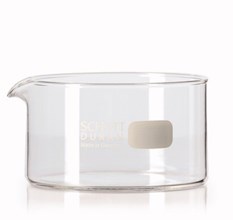
DURAN crystallizer with spout
Producer:
Nr CAT:
Capacity: [mm], 20, 40, 60, 100, 150, 300, 500, 900, 2000, 3500
Dimensions: diameter [mm], 40, 50, 60, 70, 80, 95, 115, 140, 190, 230
check -

DURAN crystallizer
Producer:
Nr CAT:
Capacity: [mm], 20, 40, 60, 100, 150, 300, 500, 900, 2000, 3500
Dimensions: diameter [mm], 40, 50, 60, 70, 80, 95, 115, 140, 190, 230
check
Laboratory crystallizers
Laboratory crystallizers are laboratory vessels with a wide range of applications in chemistry and laboratory technology. Their main function is to allow the crystallization of chemicals by slowly evaporating the solvent. Usually made of borosilicate glass or porcelain, they provide high resistance to temperature and chemicals. Crystallizers are available in various sizes, adapted to the specifics of the conducted research.
Physicochemical mechanisms of crystal formation and growth
The crystallization process in a crystallizer is staged and includes several key phases:
- Formation of supersaturated solution,
- Nucleation (i.e. the formation of the first crystal embryos),
- Crystal growth under controlled conditions,
- Separation of crystals from parent lye.
During the process, the control of temperature, evaporation rate and gentle stirring, which affects the size and quality of the crystals, play an important role. After the process, the so-called mother liquors remain, which can be further processed or purified.
Design Differences Between Crystallization Vessels and Evaporators
A laboratory crystallizer is often confused with a vaporizer, but they have different functions:
- the crystallizer has a wide, flat bottom, which promotes slow crystallization and even crystal growth,
- The evaporator has a bowl shape, which accelerates the evaporation of liquids and is used to quickly concentrate solutions.
In practice, a steamer is used to quickly remove the solvent (often in a water bath), while a crystallizer is used to obtain clean, well-formed crystals.
Application of crystallizers in laboratories and industry
Crystallizers are used not only in chemical laboratories, but also in industry:
- chemical – for purification and release of substances,
- pharmaceutical – in the production of active substances (APIs),
- food – in the processes of purification and separation of ingredients,
- material – in the production of crystals with a specific structure.
In each of these cases, crystallizer chemistry uses controlled conditions to achieve the desired purity and crystal size.
Advanced industrial apparatus in mass production
Advanced crystallizers are used in industry, which differ in design and way of working. The most common types are:
- forced-circulation (FC) crystallizers,
- Draft Tube Baffle (DTB) crystallizers
- vacuum crystallizers,
- crystallizers with surface cooling.
The selection of the appropriate system depends on the solubility curve of the substance, its viscosity and the required crystal size. Such installations are crucial in the production of fertilizers, industrial salts and pharmaceutical ingredients.
Reactors use in the pharmaceutical, food and petrochemical industries
In the pharmaceutical industry, the crystallizer plays a key role in the production of active substances (APIs), where the purity and homogeneity of the crystals have a direct impact on the quality of the drug.
In the petrochemical and chemical industries, crystallization is used to separate and purify compounds, while in the food sector to obtain the appropriate structure of crystalline products such as sugars or salts.
Raw Material Recovery Technologies and Zero Liquid Discharge Systems
Modern industrial installations using crystallizers are part of raw material recovery systems and a closed economy.
Of particular importance are the following systems:
- recovery of salts and minerals,
- industrial wastewater compaction,
- Zero Liquid Discharge (ZLD) technologies, which eliminate liquid waste.
Thanks to this, crystallization becomes not only a production process, but also an element of environmental protection.
Specialized Applications of the Term in Metallurgy and Floor Renovation
In technology and industry, the term crystallizer is not limited to laboratory chemistry and process equipment.
In metallurgy , crystallizers refer to the components of equipment responsible for the controlled cooling of liquid metal, where the crystallization process determines the crystal structure and mechanical properties of the material. The cooling rate and crystallization conditions directly affect the strength and homogeneity of the castings.
In floor renovation and stonemasonry , the term crystallizer also refers to a specialized chemical used to harden and polish stone surfaces such as marble or terrazzo. This process involves triggering a controlled chemical reaction in the top layer of the material, which increases its gloss and abrasion resistance.
In both cases, the meaning of the term deviates from the classic laboratory crystallizer, but still refers to the phenomenon of controlled formation or reorganization of the crystal structure.
Laboratory crystallizers – materials and properties
In laboratories, laboratory crystallizers are most often made of:
- borosilicate glass,
- chemical porcelain.
They are resistant to temperature and chemicals, and their simple design allows easy observation of the crystallization process. They often work with other pieces of equipment, such as laboratory glassware, beakers, cylinders, flasks or measuring glass.
Price and factors affecting the cost of crystallizers
The price of crystallizers depends on the material, size and purpose:
- glass crystallizer – from 20 to 150 PLN,
- porcelain crystallizer – from 50 to 300 PLN,
- Specialist models – a few hundred zlotys and more.
The final crystallizer price is also influenced by chemical resistance and build quality, which is important in industrial and research applications.